Computational Chemistry
Modeling Psychoactive Molecules at 5-HT2A
Several psychedelics and a common antipsychotic all bind the 5-HT2A receptor. Docking simulations estimate how well each one fits, and which contacts hold it in place.
LSD, psilocybin, DMT, mescaline, and MDMA act on the same brain target as risperidone, a widely prescribed antipsychotic. That target is the 5-HT2A serotonin receptor. Sharing a receptor does not mean sharing an effect, and part of the difference is physical. It depends on how well each molecule fits the receptor’s binding pocket and on which interactions hold it there. This project estimates those quantities computationally, using molecular docking, as a first pass before any laboratory work.
Preparing the receptor
The starting point is an experimentally solved structure of 5-HT2A from the Protein Data Bank, captured mid-bind with a prototypical hallucinogen still in the pocket. Removing that ligand leaves an empty pocket for docking new candidates.
One practical constraint shaped the setup. SwissDock, the docking software used here, limits the size of the target protein, and the full receptor of more than 18,000 atoms exceeded it. The receptor sits in a cell membrane, and only the portion exposed outside the cell is reachable by a drug in the bloodstream. A separate region inside the cell relays the resulting signal onward. That intracellular region was removed without touching the binding pocket, and a structural alignment against the full receptor confirmed the trim had not distorted the pocket.
Docking six molecules
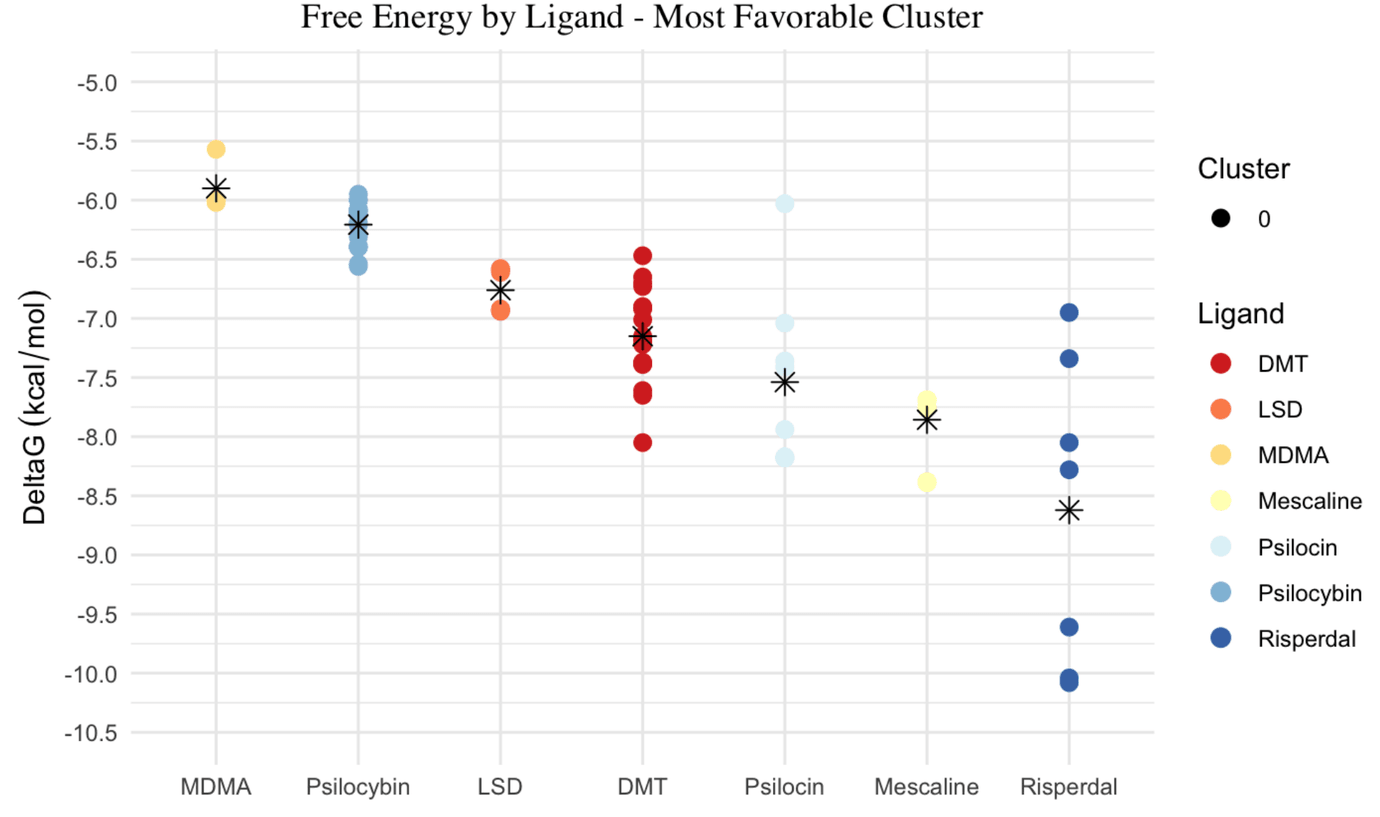
With an appropriately sized pocket, six psychoactive molecules were docked separately, alongside risperidone as a benchmark. The six were mescaline, DMT, LSD, MDMA, psilocin, and psilocybin. Docking scans the receptor for cavities, places a candidate in each one at many orientations, and estimates the binding energy, ΔG, of every resulting pose. A more negative ΔG indicates a tighter, more thermodynamically stable fit, much as a ball settles more stably into a deep bowl than a shallow one.
Four of the six, LSD, DMT, psilocin, and mescaline, settled into the same pocket that risperidone occupies, a reasonable indication that the simulation tracks the underlying biology. Risperidone bound most tightly at roughly -10 kcal/mol, with mescaline the closest of the group at about 1.5 kcal/mol behind. Each kcal/mol corresponds to a several-fold shift in how favored one pose is over another at body temperature, so 1.5 kcal/mol separates a strong binder from a clearly weaker one.
Two molecules missed the pocket. Psilocybin is phosphorylated and must be dephosphorylated to psilocin before it can act on this receptor, so its failure to dock is an expected negative control rather than an error. MDMA is the harder case. It is known to act on 5-HT2A and shares structural features with mescaline, yet it docked to an exposed patch outside the pocket. That result is either a genuine sign that MDMA binds at an unconventional site or a limitation of this docking algorithm.
Which contacts hold the molecule in place
Docking indicates where a molecule sits but not why it stays. To probe that, three pocket-lining amino acids were each substituted one at a time, and the docking was re-run with mescaline, the strongest natural binder, after each substitution.
Replacing an aspartic acid thought to form a salt bridge with mescaline’s amine group nearly eliminated binding, consistent with what is known about how this receptor holds its hallucinogenic ligands. Removing the charge removes the anchor. A second substitution, at a tryptophan expected to contribute a hydrophobic contact, changed the binding energy very little, which runs against prior published claims about that residue. The third substitution traded a hydrophobic residue for a polar one to create a new hydrogen-bond opportunity. Binding tightened by just over 1 kcal/mol, closing most of the gap to risperidone.
Where modeling fits
This does not replace a binding assay, particularly because the method has a known failure mode whereby it may propose a geometrically implausible pose, which is what appears to have happened with psilocybin and MDMA. As an inexpensive first pass, though, docking is a fast way to ask which residues contribute most to binding and which substitutions might tighten or loosen a given molecule. Given renewed clinical interest in psychedelics for conditions such as PTSD, a quick computational map of the contacts a candidate depends on is a reasonable way to decide where the slower and more expensive experiments should look.
References & notes
- Kim, K. et al. (2020). Structure of a hallucinogen-activated Gq-coupled 5-HT2A serotonin receptor. Cell, 182(6), 1574–1588.
- Grosdidier, A., Zoete, V., Michielin, O. (2011). Fast docking using the CHARMM force field with EADock DSS. Journal of Computational Chemistry, 32(10), 2149–2159.
- Structures, docking parameters, and mutation scripts available on request.