Computational Neuroscience
Predicting Antidepressant Response from EEG
Two people with the same diagnosis can need opposite drugs. Can the resting brain say which one, before the months of trial and error, or does it just look like it can?
Picking an antidepressant is mostly trial and error. Around two-thirds of patients don’t get better on the first one they try. This project asks whether resting-state EEG can predict treatment response, i.e. “fit” between patient and prescription.
Squeezing a brain signal down
An EEG is a lot of numbers. Two minutes of recording across 26 electrodes is a wide, noisy signal, and most of it has nothing to do with whether a given drug will work. An autoencoder is a small network that learns to squeeze an input down to a handful of numbers and then rebuild the original from them. If it can rebuild the signal well from that compressed code, the code has kept whatever structure mattered. It is a way of asking the data what is worth keeping before making a prediction.
A plain autoencoder never sees the outcome. It just compresses and rebuilds. The more useful version is semi-supervised, where a second small head reads the compressed code and tries to guess whether the patient got better, so the network has to find a code that stays faithful to the raw signal and also carries some hint about response. I built a recurrent version too, one that reads the EEG as a sequence in time rather than one flat average, on the idea that how brain activity moves might matter more than its overall shape. Each compressed code then went to a plain logistic regression for the actual prediction. That keeps the test fair since the autoencoder can’t memorize the answer.
The trial behind the data
The data came from iSPOT-D, a real multi-site trial that put over a thousand adults with depression on one of three common antidepressants and followed them for eight weeks. About 700 had both a clean pre-treatment EEG and a clear outcome, where symptoms had fallen by at least half. Symptom reduction is what the models tried to predict, from the EEG and a few clinical facts like age, sex, the assigned drug, and intake symptom ratings.
What the models found
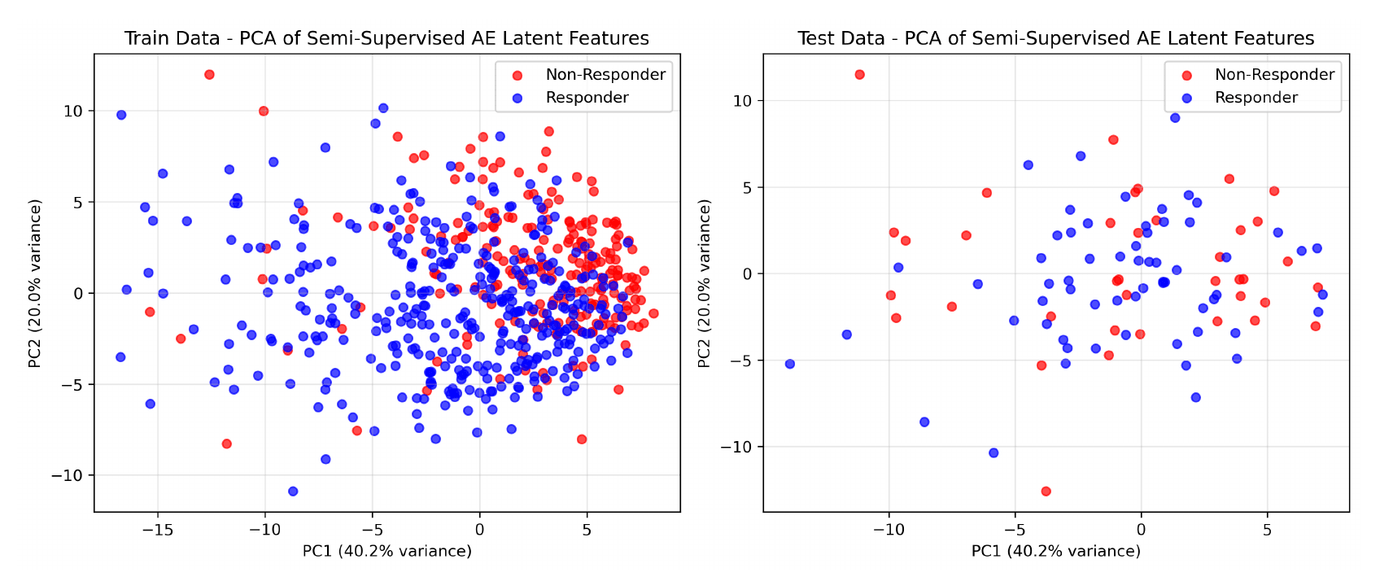
None of the versions did much better than a coin flip. The best one edged past clinical information alone. When I looked at the compressed space of the best model, the training patients showed a soft split between responders and non-responders, but that split didn’t transfer to the held-out set.
References & notes
- Watts, D., Pulice, R. F., Reilly, J., Brunoni, A. R., Kapczinski, F., Passos, I. C. (2022). Predicting treatment response using EEG in major depressive disorder: A machine-learning meta-analysis. Translational Psychiatry, 12(1).
- Williams, L. M. et al. (2011). International Study to Predict Optimized Treatment for Depression (iSPOT-D): Rationale and protocol. Trials, 12(1), 4.
- Wu, W. et al. (2020). An electroencephalographic signature predicts antidepressant response in major depression. Nature Biotechnology, 38(4), 439–447.
- Model code available on GitHub.